

Why smarter HVAC Is the next big step in superyacht efficiency
Written for Superyachttimes.com by Guest Author

HVAC systems, still largely based on 25-year-old standards, account on average for 50% of total yacht energy use – making them the single largest continuous energy consumer. The future of yacht operation is digital and data-driven, and systems are becoming connected and intelligent. Patrick Voorn, founder of Synergy The HVAC Consultancy, part of the Bond Support Services Group, explains how HVAC is central to this shift.
The superyacht industry is making considerable efforts to reduce its environmental footprint. Innovations in hybrid propulsion, waste-heat recovery, and advanced fuel management are gaining traction, driven by regulatory pressure and client demand for sustainable solutions. Yet propulsion represents only a fraction of the energy story. Yachts spend just 7–10 per cent of their time underway. During the remaining 90 per cent of their operational life while moored, at anchor or in port, other onboard systems dominate the energy demand. The largest of these is HVAC, making it the single biggest lever for reducing fuel consumption, cutting operational costs and improving efficiency.

Ready for change
Because the HVAC segment has been largely unchallenged or pressed to develop more efficient systems, a large segment of the market has remained unchanged, aside from the use of waste water for heating. Most yachts still rely on chilled-water Variable Air Volume (VAV) systems or fan coil units with make-up air units sized with generous safety margins.
These systems are robust, but often oversized, left to run in ‘set-and-forget’ mode, and rarely optimised once installed. Because performance data is limited, inefficiencies go unnoticed. The result: unnecessary chiller runtime, overactive pumps, and wasted thermal energy circulating throughout the vessel. This lack of transparency is one of the reasons why innovation has been slow. But the combination of real-time monitoring, digital twins, and AI analytics is now changing the picture.
Bringing data to the surface
Specially designed software is now able to collect over 1.5 million data points every day. From chiller units, pumps, valves, sensors, air handlers, and thermostats, we can see how the system actually performs under real-world conditions. This data feeds a digital twin – a live, virtual replica of the onboard HVAC system. The twin mirrors, among other things, temperature, flow, pressure, and energy use in real time, allowing engineers to see not only what is happening, but why.
This insight allows inefficiencies to be diagnosed with precision. Engineers can detect and correct imbalances between the technical parts; identify unnecessary energy use during low-load periods; adjust setpoints dynamically based on occupancy and climate conditions; and provide full support to ease the workload of the onboard crew. Most of the time, all of this can be done without replacing, or adding hardware, meaning large efficiency gains are possible even on yachts that are mid-life or newly delivered.

From black box to open book
Traditionally, HVAC has been a mystery to many yacht crew. Performance was judged by comfort rather than efficiency. With live data and AI-driven analysis, that is changing. Modern platforms use machine learning to recognise normal operating patterns and flag anomalies early. For example, a subtle pressure drop might indicate a developing refrigerant leak, or a small temperature drift could reveal a faulty sensor or miscalibrated valve, or persistent high energy use under light load can highlight oversized or poorly tuned components.
This turns HVAC from a passive system into an actively managed one, enabling predictive maintenance and data-driven decision-making, rather than reactive troubleshooting. Real-world deployments have shown over 30 per cent improvement in HVAC performance, translating into total vessel energy savings of 10–15 per cent when we refer to HVAC consuming 50 per cent of the total energy. That’s not just lower fuel burn and CO₂ emissions – it’s also reduced generator runtime, longer service intervals, fewer compressor starts and increase comfort for guests.
How it works
The process begins when the yacht’s HVAC drawings are provided. These serve as the foundation for configuring the software. With expertise in cybersecurity and maritime systems, Delta Digital’s specialists ensure each step is executed securely and efficiently.
In most installations, the onboard technical crew supports the setup by creating a connection to the yacht’s network and hosting a virtual server. Once the system is online, data collection begins immediately.
The first 30 days are designated as the ‘baseline period’. During this time, no changes are made to the HVAC system, allowing engineers to capture accurate operational data under normal conditions. After the baseline is established, Delta Digital’s engineers begin analysing the collected data and fine-tuning system parameters to optimise performance.
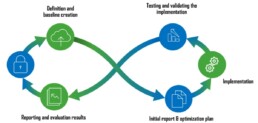
A dedicated dashboard provides a clear overview of system behaviour, showing both the original settings and the effects of any adjustments. Key Performance Indicators (KPIs) display efficiency metrics for the five most critical subsystems. A separate ‘Savings’ page quantifies energy savings relative to the baseline, offering an at-a-glance view of the improvements achieved. All data is accessible to the onboard engineering team, with historical trends available for any timeframe, from the last five minutes to the system’s first day in operation.
This is the feedback from the owner’s representative of a recently delivered 100-metre-plus yacht: “Despite our HVAC installation being new and ‘state-of-the-art’, we were aware it was not functioning as well as it should and were frustrated by the lack of transparency in the monitoring system. Despite expecting some improvements in efficiency, we are genuinely surprised by the extent of those gains with the added benefit of a much better balanced chiller system. The monitoring and trending the system provides us with have been invaluable for a better understanding of the system.”
New builds and refits
The benefits go beyond operational optimisation. For shipyards and naval architects, real performance data provides a basis for smarter design. Too often, HVAC systems are sized conservatively at every step – thermal load estimation, equipment selection, control strategy – leading to stacked safety margins. The result: oversized chillers, larger pumps, increased piping sizes, larger generators, more weight, larger technical spaced which results in reduced interior volume.
Using operational data from comparable vessels, project teams are able to right-size new systems for real-world conditions rather than worst-case assumptions; reduce equipment footprint, freeing up space for guest or crew areas; and lower generator size and fuel requirements, cutting OPEX and CAPEX.

This approach is increasingly relevant as the IMO and class societies tighten efficiency and emissions targets. Intelligent HVAC design supports compliance without compromising guest comfort. Most systems can be brought online within a matter of days and, importantly, all data is owned by the client and is fully accessible, no proprietary ‘black box’ calculations or locked-in service contracts.
Because we don’t sell HVAC systems, our recommendations are fully objective. The goal is simple: to make existing systems perform better and give crews and owners confidence that decisions are based on facts, not vendor sales targets. This independence has been particularly valuable for yacht owners, fleets and management companies, where consistent reporting and transparent KPIs are essential for benchmarking vessel performance.
This article was first published in issue 9 of How To Build It. You can read all the articles from this edition here, and stay up-to-date with all previous editions here.